Title: Africa Regional Centres of Excellence - ArcX: Climate Change Resilience.
Main Objective: Strengthen the climate change and disaster resilience in Sub-Saharan Africa, by improving scientific and technological capacities of the Regional Centers of Excellence, their co-ordination and capacity to contribute to policy and decision making.
Areas of Impact: Early Warning and Disaster Risk Reduction; Digital Transformation and AI Innovation; Climate Information Systems Strengthening; Research and Knowledge Generation; Capacity Development and Partnerships
Target Groups: African Regional Climate Centres (RCCs); National Meteorological and Hydrological Services (NMHSs); Regional Specialized Meteorological Centres (RSMCs); African Union Commission (AUC); Disaster Risk Reduction agencies; Water basin authorities; Agricultural advisory services; Climate planners; Early warning Systems; Academia and research institutions
ArcX Partners: to be defined
Component Coordinator: European Centre for Medium-Range Weather Forecasts (ECMWF)
Leading Regional Centre of Excellence (RCoE): to be defined
Scientific and Technical Support from EC - DG JRC: JRC Unit D6 (Nature Conservation and Observations); JRC Unit E1 (Disaster Risk Management).
Seagrass is found on all continents except Antarctica, covering roughly 0.1% of the ocean floor. However, its global extent remains inadequately mapped, with estimates varying between 160,387 km² and 670,000 km², posing a significant challenge for conservation efforts. The UNEP-WCMC seagrass dataset indicates that Africa harbors approximately 12% of the world’s seagrass.
Seagrass is found on all continents except Antarctica, covering roughly 0.1% of the ocean floor. However, its global extent remains inadequately mapped, with estimates varying between 160,387 km² and 670,000 km², posing a significant challenge for conservation efforts. The UNEP-WCMC seagrass dataset indicates that Africa harbors approximately 12% of the world’s seagrass.
This data represents the total built-up volume between 1975 and 2030 in 5 year intervals over cells of 1x1 km size.
It derives from the GHS-BUILT-V - R2023A spatial raster dataset, that depicts the distribution of built-up volumes, expressed as number of cubic metres. The data report about the total built-up volume and the built-up volume allocated to dominant non-residential (NRES) uses.
The dataset is part the Global Human Settlement Layer , Global, high-resolution, multi-temporal gridded data on built-up environment (built-up surface, built-up volume, residential vs. non-residential function), resident population, and settlement classification by the UN-recommended methodology “degree of urbanisation”.
The complete information about the GHSL main products can be found in the GHSL Data Package 2023 report
These layers present the application of the Degree of Urbanisation stage I methodology recommended by UN Statistical Commission to the global population grid generated by the JRC in the epochs 1975-2030 (5 years timestep).
They derive from the GHS-SMOD - R2023A.
The layers have been generated by integration of built-up surface extracted from Landsat and Sentinel-2 image data processing (GHS-BUILT-S R2023), and population data derived from the CIESIN GPW v4.11 (GHS-POP R2023).
The dataset is part the Global Human Settlement Layer, that provide global, high-resolution, multi-temporal gridded data on built-up environment (built-up surface, built-up volume, residential vs. non-residential function), resident population, and settlement classification by the UN-recommended methodology “degree of urbanisation”.
The complete information about the GHSL main products can be found in the GHSL Data Package 2023 report.
This data represents the distribution of human population between 1975 and 2030 in 5 year intervals over cells of 1x1 km size.
It derives from the GHS-POP - R2023A.
Residential population estimates between 1975 and 2020 in 5-year intervals and projections to 2025 and 2030 derived from CIESIN GPWv4.11 were disaggregated from census or administrative units to grid cells, informed by the distribution, volume, and classification of built-up as mapped in the Global Human Settlement Layer (GHSL) global layer per corresponding epoch.
The dataset is part the Global Human Settlement Layer, that provide global, high-resolution, multi-temporal gridded data on built-up environment (built-up surface, built-up volume, residential vs. non-residential function), resident population, and settlement classification by the UN-recommended methodology “degree of urbanisation”.
The complete information about the GHSL main products can be found in the GHSL Data Package 2023 report.
This data represents the distribution of human population between 1975 and 2030 in 5 year intervals over cells of 100x100 m size.
It derives from the GHS-POP - R2023A.
Residential population estimates between 1975 and 2020 in 5-year intervals and projections to 2025 and 2030 derived from CIESIN GPWv4.11 were disaggregated from census or administrative units to grid cells, informed by the distribution, volume, and classification of built-up as mapped in the Global Human Settlement Layer (GHSL) global layer per corresponding epoch.
The dataset is part the Global Human Settlement Layer, that provide global, high-resolution, multi-temporal gridded data on built-up environment (built-up surface, built-up volume, residential vs. non-residential function), resident population, and settlement classification by the UN-recommended methodology “degree of urbanisation”.
The complete information about the GHSL main products can be found in the GHSL Data Package 2023 report.
The Copernicus Global Land Service - Burnt Area products depict burn scars, surfaces which have been sufficiently affected by fire to display significant changes in the vegetation cover (destruction of dry material, reduction or loss of green material) and in the ground surface (temporarily darker because of ash). The monthly products are available at global scale in the spatial resolution of 300 m and cover the period from January 2019 to April 2022. The pixel bears the value of the day of the year in which the burn scars were visible while, if selected for mapping in this platform, the dataset shows the burn scars detected in the selected month.
This dataset provides projections of global rainfall erosivity changes, a critical metric representing the erosive force of rainfall that drives worldwide soil and nutrient loss. These maps serve as essential inputs for global and regional soil erosion assessment models. The collection details the geographical distribution of projected erosivity changes across two primary periods: 2010–2050 and 2050–2070. To account for different climate trajectories, the dataset includes models for three distinct Representative Concentration Pathway (RCP) scenarios for both timeframes: RCP 2.6 (stringent mitigation), RCP 4.5 (intermediate emissions), and RCP 8.5 (high emissions). By combining these temporal and climatic variables, users can evaluate and compare potential future soil erosion risks under varying degrees of global climate change.
Africa is projected to have the fastest urban growth rate in the world — by 2050, Africa’s cities will be home to an additional 950 million people. Urban planning and management are essential development challenges. Understanding urbanisation, its drivers, dynamics and impacts, is key to designing targeted, inclusive and foward-looking policies at the local, national and continental levels. Africapolis data and evidence supports cities and governments to make urban areas more inclusive, productive and sustainable. This map of urban population covers 7 500 agglomerations in 50 countries for the base year 2015.
Increasing water scarcity and water quality issues are serious constraints, especially for Northern Africa. A comprehensive assessment of spatial and temporal precipitation frequency is the initial step for defining public policies relating to water resources management and environmental monitoring. In the agricultural sector, a detailed knowledge of precipitation patterns is necessary to identify the most appropriate crop varieties for the region and to effectively manage climate related uncertainties. Precipitation frequency is also a central source of information for hazard mitigation and management. This layer shows the average annual precipitation (mm/year) for the period 1981-2017 across the continent.
Tropical moist forests have a huge environmental value. They play an important role in biodiversity conservation, the terrestrial carbon cycle, hydrological regimes, indigenous population subsistence, and human health (1-5), and are increasingly recognized as an essential element of any strategy to mitigate climate change. Deforestation, degradation, and fragmentation compromise the functioning of tropical forests as an ecosystem, leading to biodiversity loss, reduced carbon storage capacity, and an increased risk of viral disease outbreaks. Accurate characterization of changes in tropical moist forests is therefore needed to support conservation policies and to better quantify their contribution to global carbon fluxes.
This dataset comprises the following map layers:
Undisturbed tropical moist forest: Shows the coverage of undisturbed tropical moist forests remaining at the end of the year 2019.
Deforestation year map: Shows where deforestation occurred over three decades (between 1982 and 2020) and indicates the year when the forest cover was deforested for the first time (followed or not by regrowth).
Degradation year map: Shows where degradation occurred over three decades (between 1982 and 2020) and indicates the year when the forest was degraded for the first time (and remained degraded up to 2020).
Transition map: Captures the dynamics of changes in tropical moist forests between the initial observation period (1990) and the end of the year 2020.
Source: European Commission Joint Research Centre (JRC) - Tropical Moist Forests (TMF)
The Fire Information for Resource Management System (FIRMS), developed by the National Aeronautics and Space Administration (NASA), utilizes satellite observations to detect active fires and thermal anomalies. This critical information is delivered to decision-makers in near real-time, typically within three hours of the satellite observation.
This dataset consolidates active fire data across multiple rolling timeframes, specifically offering views of the last 24, 48, and 72 hours. Key technical details include:
Spatial Resolution: Each data point represents the center of a high-resolution 375 m pixel where a fire or thermal anomaly was detected.
Update Frequency: The data is refreshed twice daily to ensure the most current ground conditions are represented.
Compared to legacy satellite fire detection products with coarser resolutions (≥ 1km), this 375 m dataset offers significant operational advantages:
Enhanced Detection Capabilities: Delivers improved responsiveness for detecting smaller fires, as well as significantly better detection at night when fire activities frequently occur.
Precise Perimeter Mapping: Provides higher fidelity and accuracy when mapping the perimeters of large fires.
Primary Uses: The data is highly suited for supporting active fire tracking and management (e.g., feeding near real-time alert systems), alongside broader scientific applications that require precise fire mapping fidelity.
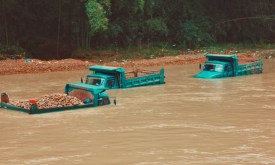
River floods are recognized as one of the major causes of economic damages and loss of human lives worldwide. Quantifying flood hazard is an essential component of resilience planning, prevention measures, emergency response, and mitigation, including insurance. This map depicts flood prone areas for flood events with a 100-year return period (i.e. with 1% chance of being exceeded in any one year). Cell values indicate water depth in meters. The map can be used to assess flood exposure and risk for population and assets.
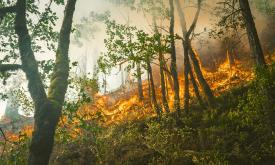
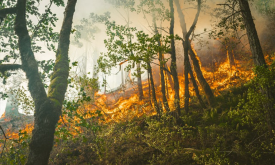
Fire is a natural part of all ecosystems. Wildfires have been burning vegetation and shaping landscapes far longer than people have been on Earth. However, changes in fire frequency and timing can result in degradation if the vegetation is not adapted to the new fire regimes. This can cause long-term damage to land biomass components affecting soil structure, nutrients and water cycling. This layer displays the areas of concern for fires related issues derived from the convergence of global evidence of human-environment interactions that can have consequences on land degradation.
This layer is part of the
World Altas of Desertification
Changes in vegetation biomass are critical in assessing land degradation. Climate variations, alone or in combination with human-induced land use and land change, can affect biomass productivity and may trigger changes in vegetation type and structure. Depending on their severity and duration, precipitation anomalies can trigger or aggravate existing land pressures. This layer displays the areas of concern for climate-vegetation trends derived from the convergence of global evidence of human-environment interactions that can have consequences on land degradation. It highlights areas with declining plant productivity in response to climate fluctuations (drought conditions in particular).
This layer is part of the
World Altas of Desertification